Contents
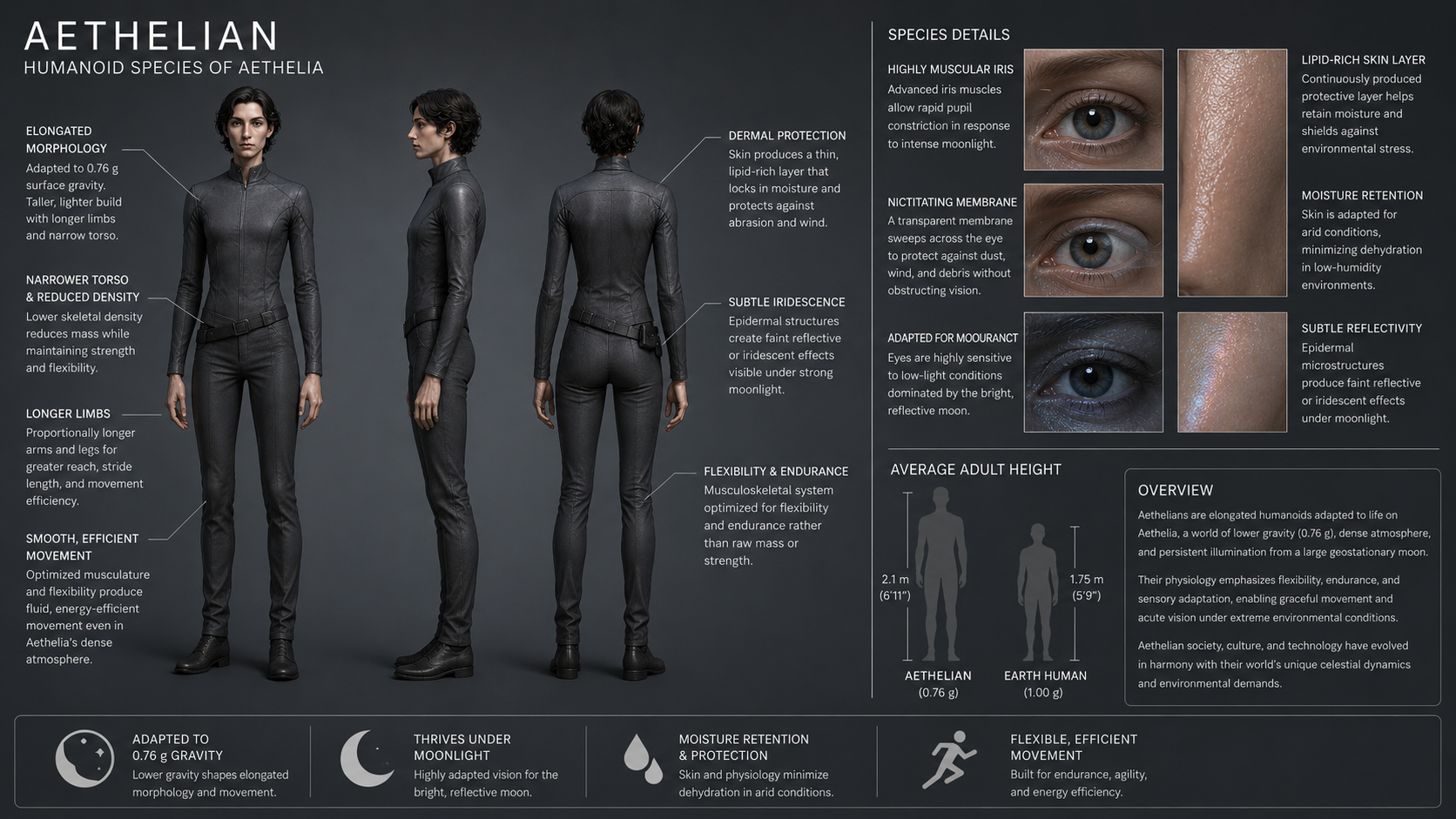
On the surface, Aethelians possess a distinctly elongated human morphology shaped by the planet’s lower surface gravity of approximately 0.76 g. Adult individuals are typically taller and more lightly built than baseline Earth humans, with proportionally longer limbs, narrower torsos, and reduced skeletal density. Their musculoskeletal system favors flexibility and endurance over raw mass, producing movement patterns that appear unusually smooth and energy-efficient under Aethelia’s gravitational and atmospheric conditions. In the planet’s dense atmosphere, even ordinary locomotion carries a slightly buoyant visual quality, and trained individuals are capable of controlled leaps and extended aerial motion difficult to replicate under Earth conditions.
Their external appearance remains recognizably human, though several anatomical adaptations reflect long-term evolution beneath Aethelia’s environmental extremes. The species’ visual system is particularly specialized due to persistent illumination from the planet’s large, highly reflective geostationary moon. Aethelian irises contain exceptionally responsive muscular structures capable of rapid pupil constriction under intense nocturnal glare conditions. Beneath the primary eyelids lies a transparent nictitating membrane that protects the eye from airborne particulates, low-humidity conditions, and sustained surface winds without significantly impairing vision.
Dermal tissue is adapted for moisture retention in the planet’s drought-prone environment. The skin continuously produces a thin lipid-rich protective layer that reduces dehydration and provides resistance against abrasive atmospheric conditions. Under daylight conditions generated by the system’s K-type primary star, Aethelian skin tones appear broadly similar to those of Earth humans. However, under the moon’s dominant nocturnal illumination spectrum, subtle structural properties within the epidermis can produce faint reflective or iridescent effects, particularly in low-angle light.
Internally, the Aethelian respiratory and circulatory systems are highly specialized for survival within an atmosphere containing approximately 44% oxygen at nearly twice Earth-normal surface pressure. Their lungs are smaller and more compact than those of humans from Earth, with reinforced alveolar membranes and highly regulated oxygen-transfer mechanisms designed to minimize oxidative damage and oxygen toxicity. Resting respiration rates are slower and deeper than human averages, allowing efficient gas exchange within the dense atmosphere while limiting excessive oxygen intake.
The cardiovascular system exhibits similarly specialized adaptations. Blood vessels possess elevated elasticity and resistance to oxidative stress, supported by complex antioxidant biochemistry present throughout the circulatory system. Combined with efficient peripheral blood-flow regulation, these traits provide strong thermal stability during exposure to Aethelia’s cold surface temperatures and low-humidity conditions. Collectively, these adaptations represent a long evolutionary response to the planet’s high-oxygen atmosphere, dense air pressure, low gravity, and prolonged environmental stability over geological timescales.
▼Enclosed Urban Environments
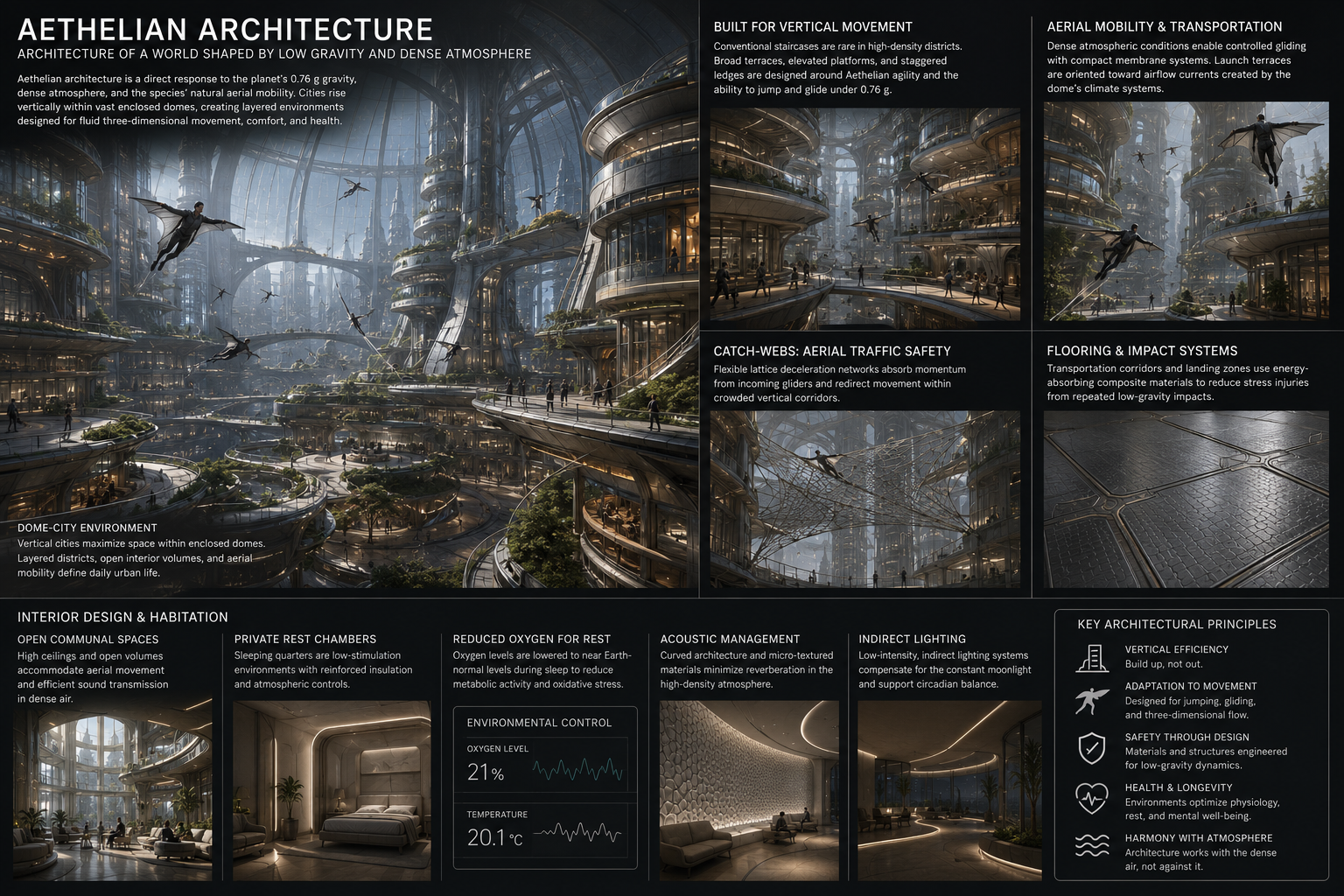
Aethelian architecture is heavily shaped by the interaction between low surface gravity, dense atmospheric conditions, and the species’ highly adapted locomotion. Urban environments within the major dome-cities emphasize vertical spatial organization rather than horizontal expansion, resulting in layered, multi-level infrastructure with extensive open interior volumes. Conventional staircases are relatively uncommon in high-density districts, replaced instead by broad terraces, elevated platforms, and staggered transitional ledges designed around the population’s ability to perform controlled vertical movement under 0.76 g conditions.
Public and residential structures commonly incorporate ceiling heights significantly greater than Earth architectural norms, often exceeding five meters in primary circulation areas. Floor surfaces within transportation corridors and landing zones utilize energy-absorbing composite materials engineered to reduce long-term stress injuries associated with repeated low-gravity descents and impacts. These materials typically combine flexible metallic polymers with woven mineral composites capable of distributing kinetic force efficiently while remaining resistant to atmospheric oxidation.
Within the enclosed atmosphere of the dome-cities, aerial mobility functions as a major component of urban transportation. The dense air allows controlled gliding with relatively small aerodynamic surfaces, leading to the widespread use of wearable membrane-based glide systems integrated into civilian clothing. Residential towers, civic complexes, and transportation hubs frequently include elevated launch terraces oriented toward prevailing interior air currents generated by the dome’s climate-regulation systems.
To support large-scale aerial traffic, many cities incorporate suspended deceleration structures positioned between major buildings. These flexible lattice networks, often referred to as catch-webs, are designed to absorb momentum from incoming gliders and redirect movement safely within crowded vertical transit corridors. Over time, this infrastructure has produced highly three-dimensional urban movement patterns that differ substantially from surface-bound transportation systems typical of Earth cities.
Interior residential design reflects the physiological constraints imposed by Aethelia’s oxygen-rich, high-pressure atmosphere. Communal living spaces are generally open and acoustically resonant due to the efficient transmission of sound through dense air. In contrast, private sleeping quarters are constructed as environmentally regulated low-stimulation chambers with reinforced insulation and atmospheric controls. During rest cycles, oxygen concentration within these rooms is commonly reduced closer to Earth-normal partial pressure levels in order to moderate metabolic activity and reduce long-term oxidative stress during sleep.
Acoustic management is also a major component of interior engineering. Curved structural geometry and micro-textured wall materials are widely used to minimize persistent reverberation within enclosed habitats, particularly under high atmospheric density conditions where sound propagation is significantly amplified. Combined with low-intensity indirect lighting systems designed to compensate for the planet’s persistent nocturnal illumination, these architectural approaches create controlled low-energy environments optimized for psychological recovery and long-duration habitation.
▼Combustion Constraints
The greatest structural hazard on Aethelia is the atmosphere itself. With atmospheric pressure approaching 1.99 atmospheres and oxygen concentrations near 44%, the planet’s air contains more than four times the oxygen density present at Earth sea level. Under these conditions, combustion reactions occur with exceptional speed and intensity. Minor ignition events that would be relatively harmless on Earth, such as static discharge, electrical arcing, or friction sparks, can rapidly escalate into severe fire events if combustible material is present. Fires on Aethelia ignite faster, burn hotter, and spread more aggressively than their terrestrial equivalents, forcing the civilization to treat fire prevention as a foundational element of engineering and urban planning.
As a result, naturally flammable structural materials are almost entirely absent from Aethelian construction. Wood, in particular, is considered unsuitable for large-scale architectural use due to its cellulose-rich composition and tendency to behave as an extremely efficient fuel source under high-oxygen conditions. Even treated timber presents substantial risk, especially within enclosed pressurized environments where rapid flame propagation can become catastrophic within seconds. Historical records indicate that several early urban settlements suffered devastating firestorms before the widespread adoption of non-combustible construction standards.
The dangers associated with organic material extend beyond architecture. During seasonal warming periods, portions of Aethelia’s drought-prone ecosystems experience frequent combustion events triggered by lightning activity, volcanic heating, or mechanical friction within dry vegetation zones. Many native plant analogues possess dense carbon-rich internal structures and low moisture retention, making wildfire behavior particularly difficult to control during peak dry seasons. These environmental conditions contributed heavily to the long-standing cultural aversion toward combustible materials within populated regions.
Modern Aethelian architecture relies almost entirely on non-reactive structural materials engineered for thermal resistance and atmospheric stability. Primary frameworks are typically constructed from titanium alloys, copper-bronze composites, basalt-reinforced ceramics, and other oxidation-resistant materials capable of withstanding both high oxygen exposure and prolonged environmental stress. Interior surfaces favor polished volcanic stone, dense mineral composites, and textured smart-ceramic materials designed to provide thermal comfort without introducing flammability risks.
Synthetic textiles and flexible interior materials are similarly specialized. Fabrics, insulation layers, and decorative coverings are commonly manufactured from silicate fibers, fluoropolymer meshes, and non-combustible composite weaves specifically developed for high-oxygen habitation environments. Across most major settlements, building codes strictly regulate the presence of untreated organic compounds within enclosed structures, making fire safety not merely an engineering concern, but one of the defining principles of Aethelian civilization itself.

▼Waste Reclamation Systems
In a sealed dome-city filled with a volatile 44% oxygen atmosphere, trash disposal cannot involve open landfills or standard incinerators. On Earth, burying garbage leads to methane gas buildup, which poses a severe explosion risk in Aethelia’s hyper-reactive air. Similarly, traditional burning would spark uncontrollable, blindingly hot infernos that would rapidly consume the dome's oxygen supply and choke the citizens with toxic gasses. To survive, the Aethelians must treat waste management as a strict, highly automated system of absolute containment and molecular breakdown.
Every Aethelian home is equipped with a specialized "disposal chute" lined with non-reactive ceramic plating. Rather than throwing away mixed trash, citizens use automated sorting bins that separate items by their base elements using chemical sensors. Organic waste, such as food scraps, is immediately sealed in airtight canisters and flooded with pure nitrogen gas to suppress any potential spark. These canisters are then sent via a high-speed pneumatic tube system directly to deep subterranean facilities located safely beneath the city's foundations, far away from the delicate dome atmosphere.
The primary method for destroying trash on Aethelia is Plasma Arc Gasification (PAG). Instead of using fire, industrial disposal plants use high-voltage electricity to create a controlled plasma torch reaching temperatures over 5,000°C. Inside these sealed, nitrogen-purged chambers, the intense heat breaks the molecular bonds of the trash instantly, turning organic matter into a useful synthetic gas and melting metals and plastics into a safe, non-flammable vitreous slag. This slag is cooled into glassy stone blocks used to pave roads and reinforce the foundations of the dome-cities, ensuring that absolutely nothing is wasted or left to rot.
▼Aethelian Material Fashion
On Aethelia, clothing design is shaped as much by atmospheric chemistry as by aesthetics or social custom. In an environment containing approximately 44% oxygen at nearly twice Earth-normal atmospheric pressure, conventional combustible textiles present unacceptable safety risks. Natural fibers such as cotton, wool, and untreated cellulose-based fabrics are almost entirely absent from civilian use, while many common Earth synthetic materials are considered unsuitable without extensive chemical stabilization. As a result, Aethelian textile manufacturing relies heavily on engineered silicate fibers, oxidation-resistant fluoropolymer weaves, flexible ceramic-thread composites, and ultra-thin metallic microfilaments designed to remain stable under high-oxygen conditions.
Despite the restrictive material requirements, Aethelian fabric engineering is highly advanced. Modern garments are lightweight, flexible, and thermally adaptive, with surface textures designed to replicate the softness and mobility of Earth fabrics while maintaining exceptional flame resistance and structural durability. Most civilian clothing also incorporates electrostatic discharge suppression layers in order to minimize accidental ignition hazards within densely populated dome environments.
The structure of Aethelian fashion is closely linked to the species’ aerial urban mobility. Due to the combination of lower gravity and dense atmospheric conditions, controlled gliding has become an integrated part of daily transportation within major dome-cities. Many garments therefore incorporate deployable aerodynamic surfaces directly into their construction. The most recognizable example is the Glide-Chlamys, a long-form outer garment combining decorative clothing with functional glide architecture.
These garments are typically woven from high-tensile carbon composite fibers reinforced with semi-rigid smart-material supports embedded throughout the fabric structure. During aerial transit, magnetic or electroactive seam systems can temporarily stiffen sections of the garment into stable aerodynamic surfaces, allowing controlled descents and short-distance gliding between elevated transit platforms. While not capable of powered flight, the system significantly reduces the energy cost of vertical urban movement and has become deeply integrated into civilian life, architecture, and fashion culture.
Coloration within Aethelian textiles relies primarily on structural optical engineering rather than traditional chemical pigmentation. Microscopic surface etching and layered nanostructures manipulate reflected light wavelengths in a manner similar to structural coloration observed in certain Earth birds and insects. Under daylight conditions produced by Aethelia’s K-type primary star, garments commonly display subdued metallic hues such as deep jade, blue-gray, charcoal, and oxidized bronze. Under nocturnal illumination from the planet’s large reflective moon, these same materials exhibit pronounced spectral shifting, producing iridescent bronze, teal, and copper-toned reflections across moving surfaces.
As a result, clothing on Aethelia functions simultaneously as environmental protection system, transportation utility, and visual cultural expression, reflecting the civilization’s long adaptation to a high-oxygen atmosphere, vertical urban design, and permanently illuminated night environment.

▼Non-Combustion Culinary Systems
Within Aethelian dome-cities, the use of open combustion is heavily restricted due to the extreme fire behavior associated with the planet’s high-oxygen atmosphere. In environmental conditions approaching 44% oxygen at nearly two atmospheres of pressure, even minor uncontrolled ignition sources can escalate rapidly into severe structural fires. As a result, conventional combustion-based technologies common throughout much of Earth’s industrial history, including gas stoves, exposed heating coils, candles, and open flames, were largely eliminated early in Aethelian urban development.
Modern Aethelian culinary systems rely almost entirely on sealed electrical heating technologies designed to minimize ignition risk while maintaining precise thermal control. Domestic and commercial kitchens are built around magnetic induction systems, ceramic thermal-transfer surfaces, and enclosed high-efficiency heat-core appliances. Cooking areas typically feature continuous countertops constructed from polished volcanic stone, basalt composites, or non-reactive ceramic-glass materials selected for thermal stability, oxidation resistance, and ease of decontamination within dense atmospheric environments.
Most cookware is manufactured from specialized conductive alloys optimized for induction heating. Rather than transferring heat through exposed elements, induction fields generate thermal energy directly within the cooking vessel itself, reducing both atmospheric exposure and accidental ignition hazards. For industrial-scale food preparation, many facilities utilize sealed thermal-core ovens employing internally contained liquid-metal heat-transfer systems. These units provide highly stable temperature regulation while isolating reactive thermal components from the surrounding oxygen-rich atmosphere.
The absence of open flame has significantly influenced the development of Aethelian cuisine. Traditional Earth cooking methods dependent on combustion, smoke exposure, or direct flame contact are largely absent, leading to alternative approaches centered on pressure chemistry, controlled thermal gradients, and precision energy application. High-pressure marination systems, ultrasonic structural modification, and localized radiant heating are common culinary techniques throughout advanced urban centers.
One of the most widespread technologies in professional food preparation is low-duration laser surface caramelization. These systems apply concentrated thermal energy directly to the outer molecular layers of food materials, producing rapid browning and texture development while minimizing broader atmospheric heating. Combined with dense-atmosphere thermal retention and highly efficient heat-transfer systems, Aethelian cooking methods tend to emphasize precision, speed, and controlled energy efficiency over the slower combustion-driven culinary traditions historically associated with Earth civilizations.
▼Non-Combustion Manufacturing
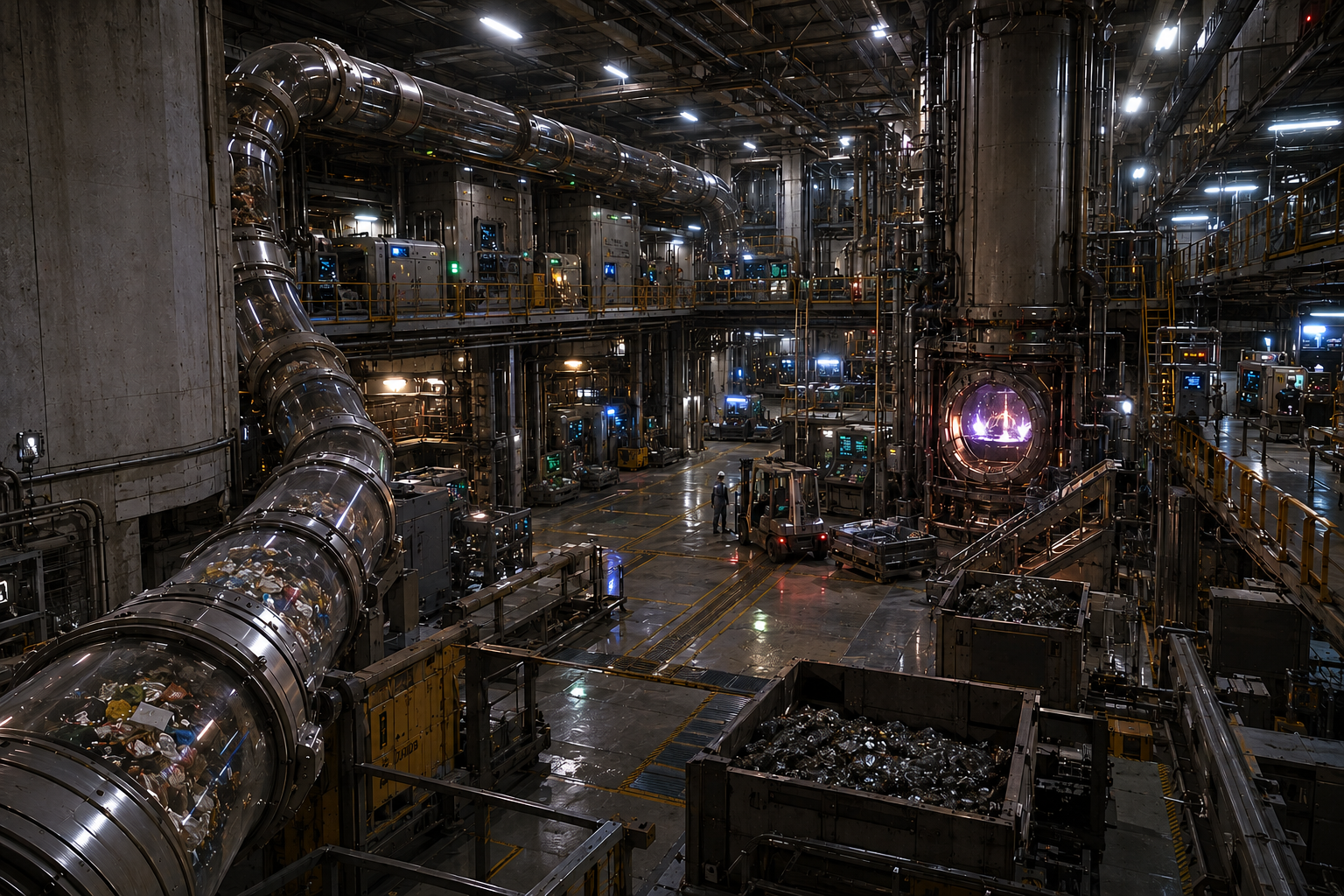
Advanced Aethelian civilization depends heavily on large-scale metallurgy, precision manufacturing, and high-temperature materials engineering. However, industrial processes involving molten metals present major hazards within Aethelia’s oxygen-rich atmosphere. At approximately 44% atmospheric oxygen and nearly twice Earth-normal pressure, uncontrolled high-temperature oxidation can escalate rapidly, making conventional combustion-driven smelting systems impractical for large-scale urban industry. As a result, Aethelian heavy manufacturing developed around strict atmospheric isolation, electrical energy transfer, and inert-environment processing technologies.
Industrial facilities are typically separated from residential population centers and constructed either within heavily reinforced subterranean complexes or inside isolated industrial domes with independent atmospheric regulation systems. High-temperature processing zones operate under controlled inert atmospheres composed primarily of nitrogen, argon, or mixed non-reactive industrial gases. Prior to active operations, oxygen concentrations within smelting chambers and fabrication bays are reduced to near-zero levels in order to eliminate uncontrolled oxidation and ignition risk during thermal processing.
Within these sealed environments, metals and advanced composites can be heated safely to extreme temperatures using non-combustion energy systems. Most large-scale metallurgical operations rely on high-frequency induction furnaces, where alternating electromagnetic fields generate heat directly within conductive materials without exposed flame or combustion byproducts. This approach allows precise thermal regulation while minimizing atmospheric contamination and ignition hazards.
For specialized high-temperature applications, many industrial sectors also employ concentrated solar thermal systems. Due to the planet’s elevated stellar insolation, orbital and surface mirror arrays are capable of focusing substantial amounts of solar energy into sealed processing chambers. These solar furnaces are commonly used in the production of advanced ceramics, refractory alloys, and high-temperature composite materials required for aerospace structures, dome engineering, and atmospheric infrastructure.
Because many industrial environments remain unsafe for direct biological occupancy during active operation, large portions of Aethelian heavy industry are highly automated. Manufacturing floors are populated primarily by non-sparking robotic systems constructed from oxidation-resistant alloys and ceramic composites engineered for inert-atmosphere operation. Human supervisors and engineering personnel typically monitor production remotely from isolated control centers protected by redundant atmospheric shielding and continuous oxygen-regulation systems.
This industrial framework has profoundly influenced Aethelian civilization. Unlike many Earth industrial traditions historically built around combustion and open thermal processes, Aethelian engineering culture developed around containment, precision energy transfer, atmospheric control, and long-duration operational stability. Over time, these principles became central not only to industrial safety, but to the broader technological philosophy of the civilization itself.
▼Hydrological Economics
Aethelia possesses an extremely limited planetary hydrosphere, and conventional rainfall is effectively absent across most of the surface. With only trace quantities of accessible water distributed across the planet’s crust and atmosphere, large-scale evaporation and precipitation cycles comparable to those of Earth never developed. The atmosphere contains relatively little moisture despite its high density, and the planet’s arid surface conditions prevent the formation of stable oceanic weather systems or long-duration storm fronts. As a result, liquid water on Aethelia exists primarily within isolated deep basins, seasonal glacial reservoirs, subsurface ice deposits, and atmospheric frost cycles rather than widespread planetary oceans.
The planet’s hydrology is instead dominated by extreme seasonal axial mechanics. Due to Aethelia’s axial tilt of approximately 86.8 degrees, polar regions periodically experience prolonged intervals of direct stellar exposure during local summer phases. During these seasonal transitions, surface temperatures in illuminated polar zones can rise rapidly from deep subfreezing conditions to temperatures exceeding 30°C over relatively short timescales. This produces an intense annual melt period commonly referred to as the Summer Flash-Thaw.
During the Flash-Thaw, accumulated glacial masses and ancient polar ice deposits undergo rapid surface melting, generating large transient river systems across otherwise dry terrain. These seasonal torrents transport substantial quantities of meltwater toward the planet’s primary deep-water basin and smaller regional reservoirs before evaporation, refreezing, and atmospheric loss reduce surface flow once again. For much of Aethelian civilization, this brief hydrological phase functions as the primary annual replenishment cycle upon which long-term water storage systems depend.
Outside the thaw period, most populated regions rely heavily on atmospheric frost deposition and engineered water recovery systems. Although atmospheric humidity remains relatively low, the dense 1.99-atmosphere air retains enough suspended moisture to support periodic deposition events during rapid nocturnal cooling cycles. Under sufficiently low temperatures, atmospheric water vapor bypasses liquid condensation entirely and deposits directly as crystalline frost across exposed surfaces, particularly on conductive exterior structures and uninsulated terrain.
Aethelian dome-cities are therefore designed to function as large-scale atmospheric collection systems. Exterior structural surfaces incorporate extensive thermal-regulation ribs, conductive condensation lattices, and active cooling networks intended to maximize frost accumulation and moisture recovery during nighttime temperature declines. Automated collection vehicles and surface drones harvest deposited ice prior to sunrise, transporting it into sealed processing facilities where it is purified, melted, and integrated into municipal storage reserves.
In addition to frost recovery, many settlements employ continuous atmospheric water-harvesting infrastructure. These systems use controlled thermal gradients, pressure differentials, and adsorption-condensation technologies to extract trace moisture from the dense atmosphere. The planet’s relatively high air density improves overall collection efficiency, allowing large condenser arrays integrated into dome superstructures to recover usable water continuously despite the atmosphere’s low absolute humidity.
Because accessible water is both environmentally scarce and energetically expensive to recover, Aethelian civilization developed around strict hydrological management and near-total recycling efficiency. Major water reserves, including the planet’s largest deep basin and smaller strategic reservoirs, are administered under centralized governmental authority and protected as critical infrastructure zones. Unauthorized extraction, contamination, or waste of potable water is treated as a major criminal offense due to the potential risk posed to enclosed population centers.
Urban water systems operate as tightly regulated closed-loop ecosystems. Domestic, industrial, agricultural, and sanitation water supplies are continuously monitored through automated recovery networks and multi-stage purification systems designed to minimize unrecoverable loss. As a result, water management evolved beyond simple resource administration and became one of the central organizing principles of Aethelian civilization.
This scarcity has also profoundly shaped social and economic structures. The institutions responsible for maintaining long-distance aqueduct systems, reservoir infrastructure, and atmospheric harvesting networks became some of the most politically influential organizations on the planet, often referred to collectively as the Water Baronies. In many regions, economic value is partially indexed to guaranteed water access, and municipal ration systems distribute quantified water allocations through tightly controlled civic infrastructure.
Water scarcity also influences everyday cultural behavior. Within many Aethelian societies, the offering of chilled, purified drinking water to a guest is considered a significant gesture of trust and respect, reflecting the broader cultural understanding that water is not merely a commodity, but one of the fundamental conditions of survival itself.
▼Hydrological Transit Networks
The transportation and distribution of water across Aethelia is managed through the Trans-Continental Aqueduct Grid, a planetary-scale network of reinforced pipelines extending across thousands of kilometers of arid terrain. Because accessible liquid water is both environmentally scarce and economically indispensable, the aqueduct system functions as one of the most strategically important infrastructures on the planet. The pipelines themselves are constructed from corrosion-resistant titanium-bronze composite alloys designed to remain stable under long-term exposure to high-pressure oxygen-rich atmospheric conditions.
To protect transported water from thermal loss, freezing, and contamination during transit across extreme surface environments, the conduits are heavily insulated using multilayer aerogel composites and active thermal-regulation systems. In exposed regions, pipelines are either partially buried beneath silicate-rich surface material or constructed with low-profile aerodynamic shielding intended to reduce mechanical stress from sustained atmospheric wind forces and seasonal thermal fluctuations.
The movement of water through the aqueduct system is maintained by a distributed network of subterranean pumping and regulation facilities positioned at regular intervals along the transport corridors. Rather than relying entirely on conventional mechanical impeller systems, many major transit lines utilize advanced magnetohydrodynamic pumping technologies. In these systems, electrically conductive fluid channels and electromagnetic induction arrays generate controlled pressure gradients that move water efficiently through sealed low-friction interiors while minimizing mechanical wear and ignition hazards associated with large-scale industrial machinery in oxygen-rich environments.
These pumping facilities are typically constructed as heavily reinforced underground complexes isolated from civilian population centers. Most operations are highly automated and staffed primarily by non-sparking robotic maintenance systems engineered for inert-atmosphere industrial work. Primary energy supply is commonly derived from geothermal infrastructure connected to tectonically active mantle regions beneath the planet’s crust, providing stable long-duration power generation independent of atmospheric conditions.
Because even relatively small disruptions to the aqueduct system can threaten the survival of isolated dome populations, the network is monitored continuously through a combination of automated structural diagnostics and dedicated patrol operations. Specialized infrastructure security units oversee major transport corridors using long-endurance atmospheric patrol craft adapted for low-gravity, dense-air flight conditions. These vehicles employ ultrasonic imaging, thermal analysis, and pressure-monitoring systems to identify microfractures, seal degradation, or structural instability before catastrophic failures occur.
In the event of a detected breach, automated containment systems immediately isolate damaged pipeline segments using high-speed pressure shutters and redundant bypass routing. Maintenance drones equipped with smart-ceramic repair compounds and rapid structural stabilization tools are then deployed to restore operational integrity with minimal water loss.
Over time, the aqueduct grid evolved beyond a simple utility network and became one of the foundational structures of Aethelian civilization itself. Control over water transportation infrastructure confers enormous economic and political influence, and the uninterrupted operation of the system is considered essential to the continued survival of the planet’s enclosed urban societies.
▼Hydrological Law and Enforcement
Within Aethelian civilization, water security is treated as a matter of collective survival rather than simple resource management. Because every dome-city operates as a tightly regulated closed-loop ecosystem with limited external replenishment capacity, the contamination, loss, or unauthorized diversion of water is classified as a major civic offense under planetary law. Over thousands of years, this environmental dependence gave rise to an extensive legal framework centered around hydrological accountability, administered through specialized judicial institutions commonly referred to as the Hydrological Tribunals.
Most minor violations involve inefficient water usage, unauthorized overconsumption, failure to report infrastructure leaks, or negligence within domestic recycling systems. These offenses are generally handled through administrative penalties rather than incarceration. Citizens found responsible may face temporary suspension of discretionary water allocations, reductions in nonessential consumption privileges, mandatory conservation labor assignments, or restricted access to high-consumption public facilities.
In many urban regions, individuals under hydrological sanction are also required to wear visible civic identification markers indicating active resource violations. While controversial in some population centers, supporters of the system argue that public accountability reinforces the collective discipline necessary for survival within enclosed ecological habitats. Common restitution programs include participation in frost-harvest operations, atmospheric condenser maintenance, reservoir sanitation work, and infrastructure repair assignments associated with municipal water recovery systems.
More serious crimes, particularly those involving deliberate contamination, infrastructure sabotage, unauthorized reservoir access, or large-scale theft from municipal reserves, are prosecuted as threats to public survival. Convicted offenders may be sentenced to long-term labor service within hazardous industrial sectors, including subterranean aqueduct maintenance complexes, geothermal pumping facilities, or remote environmental recovery operations located outside major population domes. These assignments are physically demanding and carry elevated environmental risk due to exposure to extreme temperatures, pressure systems, and isolated operating conditions.
The most severe category of hydrological crime involves intentional attacks against critical water infrastructure, including reservoir poisoning, aqueduct sabotage, or attempts to destabilize closed-loop municipal recycling systems. Such acts are regarded not merely as criminal offenses, but as existential threats to entire population centers. In these cases, punishment can include permanent citizenship revocation, complete exclusion from protected dome habitation networks, and biological resource forfeiture under emergency survival statutes.
Under these laws, the biological remains of executed or deceased high-level offenders may legally undergo post-mortem fluid and material reclamation through state-controlled recovery systems. Officially, the practice is justified as an extension of Aethelia’s broader closed-cycle resource philosophy, in which no recoverable material, including water, is considered expendable under conditions of planetary scarcity. Although the process remains highly controversial both within and beyond Aethelian society, supporters argue that the policy reflects the civilization’s foundational principle that survival resources belong ultimately to the collective rather than the individual.
These legal structures have deeply shaped Aethelian culture and social psychology. Water is not viewed solely as a commodity or utility, but as the central stabilizing resource upon which all urban life depends. Consequently, conservation, recycling, and hydrological discipline are embedded into education, civic identity, and public ethics from early childhood onward.
▼Regional Distribution of Aethelian Civilization
Unlike Earth, where oceans dominate planetary geography, Aethelia is a lacustrine world characterized by isolated freshwater basins, extensive silicate plains, glacial reserves, and a highly uneven distribution of habitable land. Water availability remains the primary factor governing settlement location, economic activity, and political organization.
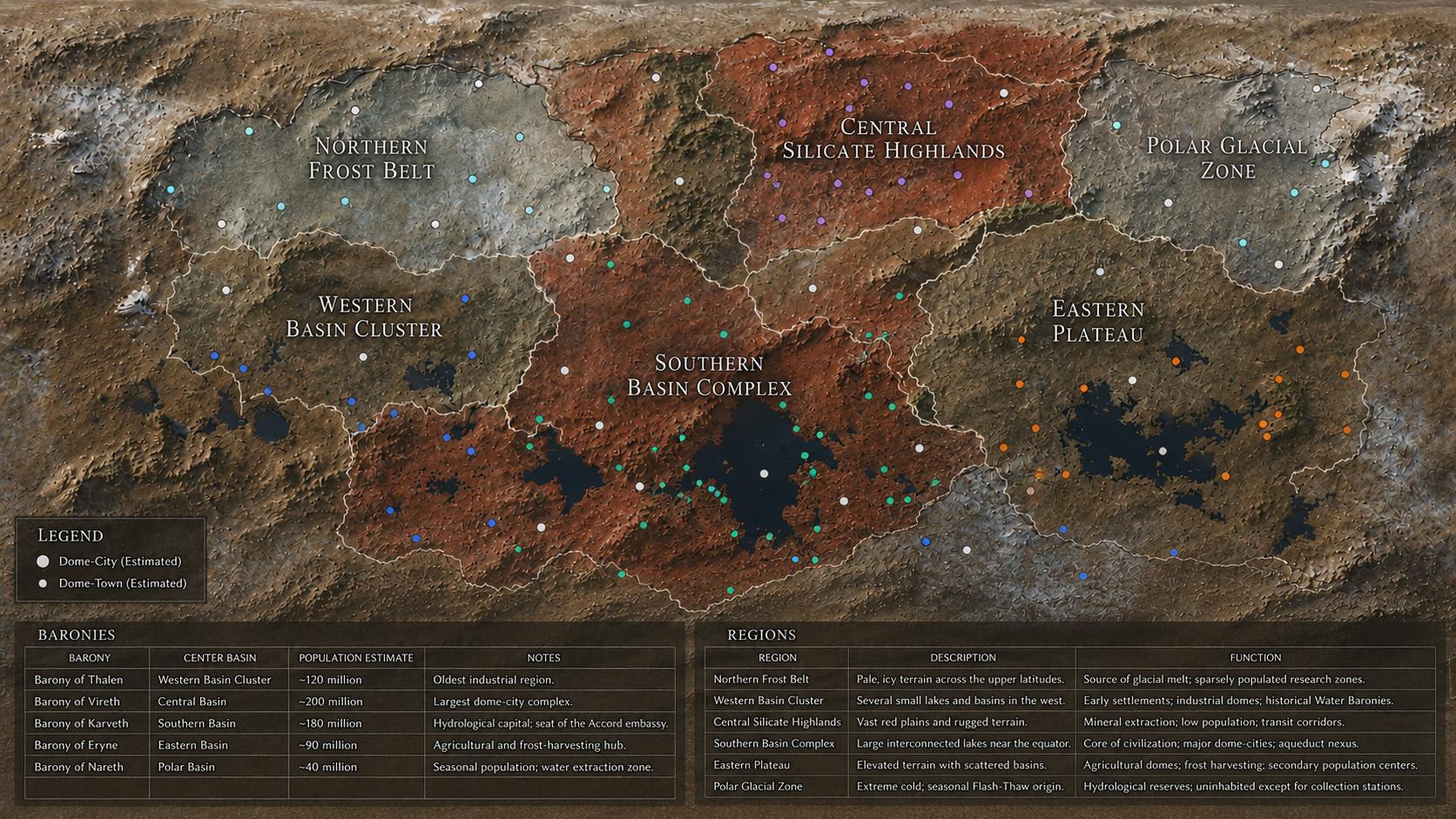
The colored markers represent estimated dome-cities and dome-towns distributed throughout the inhabited regions of the planet. Because Aethelia experiences extreme seasonal cycles, persistent water scarcity, and an atmosphere containing approximately 44% oxygen, nearly all permanent population centers exist within enclosed urban environments designed to regulate climate, conserve water, and minimize environmental hazards. Settlement density is therefore concentrated around freshwater basins, aqueduct networks, frost-harvesting infrastructure, and major transportation corridors.
The Southern Basin Complex forms the demographic and political heart of Aethelian civilization. Containing the planet's largest interconnected lake systems, this region supports the highest concentration of major dome-cities and serves as the center of government, commerce, industry, and hydrological administration. The Barony of Karveth, located within the Southern Basin, is home to approximately 180 million inhabitants and hosts numerous strategic water-management facilities that regulate continental distribution networks.
To the west lies the Western Basin Cluster, one of the oldest continuously inhabited regions on Aethelia. Numerous medium-sized lakes and enclosed valleys allowed early urban development long before modern atmospheric engineering systems emerged. The Barony of Thalen, with an estimated population of 120 million, remains an important industrial and manufacturing center. Many of Aethelia's oldest dome-cities are located within this region, reflecting its historical role in the development of organized civilization.
The Eastern Plateau serves as one of the planet's primary agricultural and frost-harvesting regions. Although less densely populated than the Southern Basin Complex, the area contains numerous settlements positioned around elevated basins and freshwater reservoirs. The Barony of Eryne supports approximately 90 million inhabitants and contributes significantly to food production, atmospheric water collection, and seasonal resource storage.
North of the major population centers lies the Northern Frost Belt, a vast region characterized by permanently cold conditions, extensive frost deposits, and sparse settlement patterns. Permanent habitation remains limited due to harsh environmental conditions, though numerous scientific outposts, extraction facilities, and seasonal research stations operate throughout the region. The Frost Belt serves as a critical source of glacial meltwater and atmospheric moisture collection for the rest of the planet.
The Central Silicate Highlands occupy a broad elevated region dominated by red mineral-rich terrain, rugged plateaus, and extensive extraction zones. Population density remains relatively low compared to the basin regions, with settlements concentrated around mining complexes, transportation hubs, and industrial processing facilities. The Highlands contain many of the planet's most significant mineral reserves and play an essential role in supporting advanced manufacturing sectors.
At the highest latitudes lies the Polar Glacial Zone, one of the least hospitable environments on the planet. Vast ice fields and ancient glacial deposits dominate the landscape, while permanent settlements remain rare. Despite its low population, the region possesses immense strategic importance because it contains some of Aethelia's largest long-term freshwater reserves. Seasonal Flash-Thaw events originating within the Polar Glacial Zone drive many of the hydrological processes that sustain civilization elsewhere on the planet.
Administratively, these regions are divided among the historical Water Baronies, autonomous territorial entities that emerged around major freshwater basins during the early development of Aethelian civilization. Although modern governance is highly centralized through the Accord system, the traditional baronial framework remains an important geographic and cultural reference. Together, the five major baronies contain an estimated combined population of approximately 632 million inhabitants, making Aethelia a moderately populated but highly urbanized world.
The map demonstrates the fundamental reality that has shaped Aethelian history for millennia: civilization exists wherever water can be secured, stored, and protected. Every major city, transportation corridor, industrial district, and political center ultimately traces its origins to the planet's most valuable resource: freshwater. In this sense, the geography of Aethelia is not defined by continents or oceans, but by the distribution of life-sustaining basins scattered across an otherwise harsh and water-limited world.