Contents
Aethelia is an ancient lacustrine terrestrial world orbiting a K-type main-sequence orange dwarf within the Scutum region of the Milky Way. Despite its comparatively small size relative to Earth, the planet supports an advanced industrial civilization adapted to one of the most chemically volatile naturally habitable environments known: an atmosphere containing approximately 44% oxygen at nearly twice Earth-normal atmospheric pressure.[1]
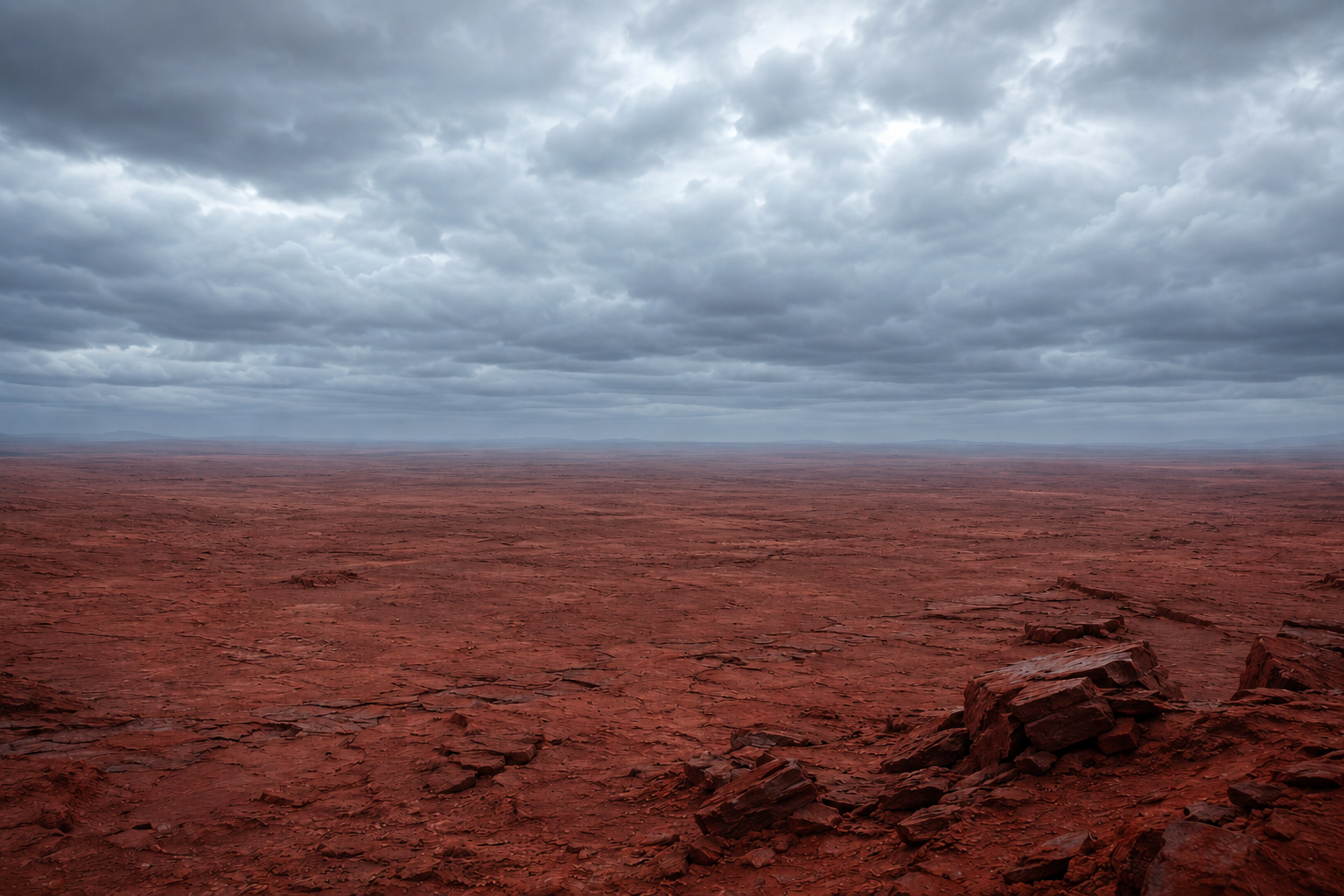
The world is defined by extreme environmental contrasts. Vast crimson silicate plains stretch across much of the surface beneath a dense blue atmosphere and near-permanent cloud cover, while isolated deep freshwater basins and seasonal glacial runoff systems sustain the planet’s enclosed urban civilizations. Unlike Earth, Aethelia possesses no true oceans and experiences virtually no rainfall. Instead, its hydrological cycles are governed by axial extremes, frost deposition, and carefully engineered atmospheric water-recovery systems.
Aethelia’s civilization evolved under immense environmental pressure. Combustion hazards, chronic water scarcity, dense atmospheric conditions, and severe seasonal thermal transitions collectively shaped every aspect of Aethelian biology, infrastructure, architecture, economics, law, and philosophy. The result is a highly controlled, technologically sophisticated society centered around containment, precision engineering, atmospheric regulation, and long-term ecological stability.
The planet is also notable for its exceptionally old biosphere. At over 12.5 billion years of age, Aethelia is among the oldest known habitable terrestrial worlds in its region of the galaxy.[2] Its ecosystems, geological systems, and native humanoid species have therefore undergone evolutionary processes operating over immense timescales compared to most younger habitable planets.
Aethelia orbits an aging K1.7 V orange dwarf star possessing approximately 0.774 solar masses and 0.359 solar luminosities.[3] The star is significantly older than Sol and exhibits relatively low metallicity, suggesting formation during an earlier galactic epoch when heavy elements were less abundant throughout the Milky Way.
Due to the reduced luminosity of its parent star, Aethelia’s habitable zone lies considerably closer to the stellar primary than Earth’s orbital position around the Sun. The planet orbits at a semimajor axis of approximately 0.45 AU and completes a full orbit every 127.107 standard days.[4]
Although the star emits less total energy than Sol, the planet still receives approximately 1.7424 times Earth-normal insolation due to its close orbital distance.[5] This elevated stellar exposure contributes significantly to Aethelia’s intense seasonal melt cycles, volatile hydrological transitions, and high atmospheric energy retention.
From the planetary surface, daylight appears broadly similar to terrestrial daylight under clear conditions, though slightly warmer in spectral tone due to the orange dwarf’s emission profile. However, dense atmospheric scattering and near-continuous cloud cover diffuse most direct illumination, producing broad low-contrast lighting conditions across much of the surface.

▼Orbital and Rotational Characteristics
One of Aethelia’s defining planetary features is its extreme axial tilt of approximately 86.87 degrees.[5] The planet rotates in a near-sideways orientation relative to its orbital plane, producing severe seasonal asymmetry between hemispheres.
As a result, large portions of the planet periodically experience prolonged intervals of near-continuous daylight followed by equally extended periods of darkness depending on orbital position. These transitions drive many of the planet’s major atmospheric and hydrological processes.
Aethelia rotates rapidly, completing a full rotational cycle every 0.7896 standard days, equivalent to approximately 18.95 hours.[5] Combined with the dense atmosphere, this relatively fast rotation contributes to stable large-scale atmospheric circulation and broad global wind systems averaging approximately 7.31 meters per second.[6]
The planet’s orbital velocity is approximately 57.74 kilometers per second, consistent with its close proximity to the system’s primary star.[5]
▼Physical Characteristics
Aethelia possesses a mean diameter of approximately 8,518 kilometers, or roughly 66.8% the diameter of Earth.[3] Despite its smaller size, the planet maintains a relatively high mean density of 6.3033 g/cm³ due to its unusually large metallic core, which comprises approximately 47.3% of the planet’s internal structure.[7]
Surface gravity averages approximately 7.49 m/s², or 0.764 Earth gravity.[3] This reduced gravity significantly influences native biology, architecture, transportation systems, and urban design.
Internally, the planet consists primarily of a large metallic core surrounded by a silicate mantle comprising approximately 52.7% of planetary mass. Surface and subsurface water reserves are exceptionally limited, with the total planetary water envelope estimated at only 59 parts per million.[7]
Despite this scarcity, isolated hydrological reservoirs persist due to deep basin formation, glacial accumulation cycles, and atmospheric recovery processes.
▼Atmosphere
Aethelia’s atmosphere is among the most chemically distinctive aspects of the planet.
Surface atmospheric pressure averages approximately 1.99 atmospheres, with air densities ranging above 2.3 kg/m³ near sea level—nearly double Earth-normal atmospheric density.[1] This dense atmosphere substantially alters aerodynamics, thermal retention, acoustics, combustion behavior, and atmospheric transport systems. The atmosphere is composed primarily of:
- Nitrogen (N2): 52.8%
- Oxygen (O2): 44%
- Water Vapor (H2O): 3.01%
- Carbon Dioxide (CO2): 0.14%
The exceptionally high oxygen concentration creates one of the defining environmental constraints of Aethelian civilization. Combustion reactions occur with extreme speed and intensity under these atmospheric conditions, making uncontrolled ignition events extraordinarily dangerous.
As a consequence, open flames, combustible construction materials, combustion-based engines, and conventional industrial smelting technologies are heavily restricted or entirely absent throughout most advanced population centers.
Atmospheric density also dramatically improves lift generation and aerodynamic efficiency. Combined with lower gravity, this allows widespread use of controlled gliding systems, vertical urban mobility, and dense-air atmospheric transportation technologies.
Acoustically, sound propagates efficiently through the dense atmosphere, requiring extensive architectural sound-dampening systems within enclosed habitats.
The atmosphere extends to an approximate height of 131.8 kilometers, with a tropopause located near 18.42 kilometers.[8]
▼Climate and Weather
Despite its dense atmosphere and significant water vapor content, Aethelia experiences almost no rainfall across most of its surface.
The planet lacks large oceans capable of sustaining Earth-like evaporation and precipitation cycles. Instead, the hydrological system is dominated by frost deposition, glacial storage, seasonal melt events, and atmospheric condensation engineering.
Global temperatures range from approximately -56.7°C during extreme winter phases to seasonal highs exceeding 32°C during polar summer thaw periods. Average global temperatures remain slightly below freezing at approximately -2.14°C, though atmospheric greenhouse retention contributes an estimated warming effect of 21.647°C.[9]
The sky appears blue under daytime conditions due to atmospheric scattering processes broadly similar to those on Earth. However, dense cloud cover dominates most regions of the planet, with only intermittent breaks exposing direct stellar illumination.
Weather systems are comparatively stable outside major seasonal transitions. Severe thunderstorms are relatively uncommon due to limited large-scale precipitation systems, though atmospheric winds remain persistent due to rotational and thermal dynamics.
The most important climatic event on the planet is the annual Summer Flash-Thaw.
Because of the planet’s extreme axial tilt, polar regions periodically receive intense sustained stellar exposure during local summer intervals. Temperatures rise rapidly over short timescales, causing ancient ice reserves and glacial sheets to undergo large-scale melt events. Massive temporary river systems form during these periods, transporting meltwater toward the planet’s primary lake basins before evaporation and refreezing reclaim much of the surface moisture.
Outside these thaw cycles, most populated regions rely heavily on atmospheric frost harvesting and engineered water recovery systems.
▼Hydrosphere
Aethelia possesses no true planetary oceans.
Instead, liquid water exists primarily within isolated deep basins, seasonal runoff channels, subterranean ice deposits, and atmospheric recovery systems. The largest known lake reaches depths of approximately 656 meters and serves as one of the planet’s primary strategic freshwater reserves.[10]
The hydrosphere is composed almost entirely of pure H2O with relatively low mineral contamination. Bottom pressures within the deepest lake systems can exceed 50 atmospheres.[11]
Because water is both environmentally scarce and energetically expensive to recover, nearly all Aethelian urban settlements operate as tightly regulated closed-loop hydrological ecosystems.
Water recycling efficiencies exceed 99% within most major dome-cities.[12] Frost harvesting, atmospheric condensers, glacial runoff capture systems, and trans-continental aqueduct infrastructure collectively sustain the planet’s enclosed civilizations.
The scarcity of accessible water profoundly shaped Aethelian economics, law, politics, and social behavior. Water functions not merely as a utility resource, but as one of the foundational organizing principles of the civilization itself.
▼The Bronze Moon
Aethelia possesses a single geostationary moon orbiting approximately 24,000 kilometers above the planetary surface.[13]
The moon measures approximately 2,642 kilometers in diameter, making it significantly smaller than Earth’s Moon.[13] However, due to its close orbital distance and unusual mineral composition, it dominates the nocturnal sky.
The moon possesses a distinctive bronze-copper coloration produced by oxidized metallic surface minerals and reflective silicate deposits. Under nighttime conditions, the moon casts a strong copper-toned illumination across much of the planetary surface.

Because the moon remains geostationary relative to the planet, it occupies a fixed position in the sky for large portions of the inhabited regions. This permanent nocturnal presence has deeply influenced Aethelian psychology, religion, art, architecture, navigation, and circadian biology.
The intense nocturnal illumination also contributed to the evolution of specialized visual adaptations among native lifeforms, including highly responsive pupil control systems and secondary protective eye membranes among the native humanoid species.
▼Native Biosphere
Aethelia supports a mature multicellular biosphere consisting of terrestrial, aerial, and aquatic ecosystems.
The combination of lower gravity and dense atmospheric conditions strongly influenced native evolutionary pathways. Large aerial organisms are considerably more common than on Earth due to improved lift conditions and reduced gravitational loading.
Much of the planet’s vegetation consists of dense mineral-rich forest systems adapted for drought resistance, atmospheric oxygen exposure, and periodic freeze-thaw cycles. Native flora frequently possess low moisture retention and rigid structural composition, making wildfire behavior particularly severe during seasonal warming intervals.
Animal analogues evolved under high oxygen partial pressures and therefore tend toward highly efficient respiratory systems, elevated endurance capacity, and dense vascular structures.
Archive Sources
Sources
- SATO Atmospheric Research Institute, Aethelia Atmospheric Composition Survey, Revision 12
- SATO Planetary Science Directorate, Chronological and Geological Assessment of Aethelia, Revision 15
- SATO Planetary Science Directorate, Aethelia Planetary Assessment Report, Revision 24
- SATO Stellar Cartography Division, Aethelia System Stellar Survey, Revision 8
- SATO Stellar Cartography Division, Orbital Characterization of the Aethelia System, Revision 3
- SATO Atmospheric Research Institute, Aethelia Atmospheric Dynamics Survey, Revision 11
- SATO Planetary Science Directorate, Internal Structure and Composition Analysis of Aethelia, Revision 9
- SATO Atmospheric Research Institute, Upper Atmospheric and Tropospheric Structure Survey, Revision 7
- SATO Planetary Science Directorate, Global Climate Survey of Aethelia, Revision 18
- SATO Hydrological Analysis Bureau, Strategic Freshwater Reserve Assessment, Revision 6
- SATO Hydrological Analysis Bureau, Planetary Hydrosphere Analysis Report, Revision 10
- SATO Department of Urban Sustainability, Dome-City Water Recovery and Recycling Census, Revision 4
- SATO Planetary Science Directorate, Aethelia-Luna System Assessment Report, Revision 5